

6 Isometric Exercises You NEED to Strengthen Your Whole Body – Do Them at Home!
Looking for effective strength training without equipment? Isometric exercises are your answer. These muscle-building moves require holding positions rather than moving, making them perfect for home or travel workouts while targeting multiple muscle groups simultaneously.
This guide is for beginners seeking low-impact strength training, busy professionals with limited time, frequent travelers, or anyone wanting to supplement their current routine. You’ll discover how isometric exercises build strength by creating tension in static positions—giving you impressive results with minimal space and equipment.
We’ll cover the science behind why isometrics effectively build strength, show you proper form for maximizing results, and explain how these exercises can strengthen your posterior chain for better posture and less back pain. Ready to transform your body with just a few minutes a day? Let’s get started.
What Are Isometric Exercises and Why They Work

What Are Isometric Exercises and Why They Work
Definition and muscle contraction mechanics
Isometric exercises represent a unique approach to strength training where your muscles engage without changing length. Unlike traditional exercises that involve movement, isometrics require holding a specific position while muscles remain contracted. This static contraction creates tension without any visible joint movement—essentially, your muscles work hard while appearing motionless. This form of exercise activates muscle fibers differently than dynamic movements, creating sustained tension that builds strength and endurance simultaneously.
Benefits for injury recovery and joint protection
Isometric exercises offer remarkable advantages for those recovering from injuries. Because these exercises don’t require movement at the joints, they put significantly less strain on damaged tissues while still promoting strength development. This makes them ideal for rehabilitation scenarios where maintaining muscle tone and building strength are crucial, but movement might aggravate an injury. The controlled nature of isometrics allows targeted muscle strengthening without compromising healing tissues, making them a staple in physical therapy programs. Additionally, they help improve mobility gradually by strengthening supporting muscles around sensitive joints.
Perfect for limited space and equipment-free workouts
One of the most practical benefits of isometric training is its accessibility. These exercises require no specialized equipment and can be performed virtually anywhere—making them perfect for home workouts, travel, or small living spaces. In an apartment, hotel room, or even at your desk, you can engage in effective strength training through isometric holds. This equipment-free approach eliminates common barriers to consistent exercise, allowing you to maintain strength training regardless of circumstances. They also provide an excellent way to add variety to established workout routines, preventing plateaus by challenging muscles in new ways without requiring additional equipment investments.
Isometric Exercises You NEED to Strengthen Your Whole Body – Do Them at Home!
Wall Sits for Powerful Lower Body Strength

Wall Sits for Powerful Lower Body Strength
Wall sits are an exceptional isometric exercise that can transform your lower body strength without requiring any equipment. This simple yet effective movement creates constant tension in key muscle groups, making it perfect for at-home training.
Target Quadriceps, Hamstrings, and Glutes Effectively
Wall sits primarily engage three major muscle groups in your lower body:
- Quadriceps: The large muscles at the front of your thighs bear much of the load during this exercise
- Hamstrings: Located at the back of your thighs, these muscles work to stabilize the position
- Glutes: Your buttock muscles activate to maintain proper posture and support the hold
This comprehensive engagement makes wall sits an efficient exercise for developing functional lower body strength with just one movement.
Proper Positioning and Form Techniques
To perform wall sits with correct form:
- Stand approximately 2 feet away from a sturdy wall
- Lean your back against the wall, ensuring your shoulders and hips maintain contact
- Slowly bend your knees and slide down the wall
- Lower your body until your knees form a 90-degree angle, similar to sitting in an invisible chair
- Position your knees directly above your ankles (never let them extend past your toes)
- Hold this position for at least 15 seconds to start
- Complete 2-3 sets, gradually increasing your hold time as you build strength
Maintaining proper alignment is crucial for both effectiveness and safety during this exercise.
Weight Distribution Variations for Different Muscle Focus
You can target specific muscles by adjusting your weight distribution:
- For greater glute activation: Drive your weight down through your heels while maintaining the wall sit position
- For increased quadriceps engagement: Shift more weight toward your toes (while still keeping knees behind toes)
These subtle adjustments allow you to customize the exercise based on your specific strength goals or to address muscle imbalances in your lower body.
Plank Variations for Total Core Engagement

Plank Variations for Total Core Engagement
Straight Arm Plank Hold for Full-Body Activation
The straight arm plank hold is more than just a core exercise – it’s a comprehensive movement that effectively engages multiple muscle groups simultaneously. When performed correctly, this isometric exercise activates your abdominals, quadriceps, glutes, arm muscles, chest, and shoulders, making it truly a full-body workout.
To execute a proper straight arm plank:
- Position your hands directly beneath your shoulders
- Extend your legs straight behind you
- Create a straight line from head to heels
- Engage your core by drawing your navel toward your spine
- Keep your neck neutral by gazing slightly forward at the floor
Side Plank for Oblique Strength and Stability
Now that we’ve covered the basic plank, let’s explore the side plank – an excellent variation that specifically targets your obliques and lateral stabilizing muscles. This powerful isometric exercise engages your obliques, spinal stabilizers, quadriceps, glutes, shoulder stabilizers, and hip abductors.
To perform a side plank correctly:
- Start by lying on your side
- Prop yourself up on your elbow, keeping it directly beneath your shoulder
- Stack your feet or stagger them for more stability
- Lift your hips to create a straight line from head to heel
- Keep your core tight throughout the entire hold
- Maintain a neutral spine position
Form Cues and Progression Tips
With these basic positions in mind, here are crucial form cues to maximize your plank exercises:
For straight arm plank:
- Ensure proper alignment between hands and shoulders
- Keep legs straight and active
- Maintain core engagement throughout
For side plank:
- Focus on maintaining a straight line from head to heel
- Keep your core tight to protect your lower back
- Breathe steadily throughout the hold
For those seeking greater challenges, try the advanced side plank variation with the bottom arm straight rather than bent at the elbow. This increases the intensity by creating a longer lever and requiring more stability from your core and shoulder muscles.
Remember that proper form is more important than duration. Start with shorter holds using perfect technique before progressing to longer isometric contractions.
Isometric Squat Hold for Leg Power

Isometric Squat Hold for Leg Power
The isometric squat hold is a powerhouse exercise that demands nothing but your body weight and determination. This static hold targets multiple muscle groups simultaneously, making it one of the most efficient lower body strengtheners you can perform at home.
Build quadriceps, glutes, and hamstring endurance
Isometric squat holds are exceptional for developing endurance in your primary lower body muscles. By maintaining a fixed position:
- Your quadriceps (front thigh muscles) work continuously to stabilize your knee position
- Glute muscles engage fully to support your hips and maintain proper alignment
- Hamstrings activate to balance the quadriceps and create posterior chain strength
The sustained tension during the hold forces these muscle groups to work together, increasing your muscular endurance far more effectively than traditional squats with the same number of repetitions.
Proper depth and positioning guidelines
To maximize benefits while minimizing injury risk, follow these precise form guidelines:
- Start with feet slightly wider than hip-width apart
- You may point toes slightly outward for comfort and stability
- Initiate the movement by pushing hips backward first (like sitting in a chair). This is referred to as a “hinge” movement.
- Bend knees while avoiding pushing them too far forward
- Lower your body until:
- Your thighs are parallel to the floor, or
- Your buttocks are slightly below knee level
- Keep your feet planted firmly with heels down throughout
- Maintain a long, neutral spine position – avoid rounding your back
The proper depth ensures maximum muscle activation while protecting your joints. If you experience knee pain, try a slightly higher position until you build more strength.
Hold duration and set recommendations
For optimal results with isometric squat holds:
- Begin with 10-second holds if you’re new to the exercise
- Progress gradually to 30-second holds as your strength improves
- Complete 3 to 5 sets per workout session
- Return to the standing position between each set
- Rest 30-60 seconds between sets to allow partial recovery
This protocol creates sufficient time under tension to stimulate muscle growth and endurance improvements without overwhelming your nervous system or risking form breakdown.
Dead Hang for Upper Body Endurance
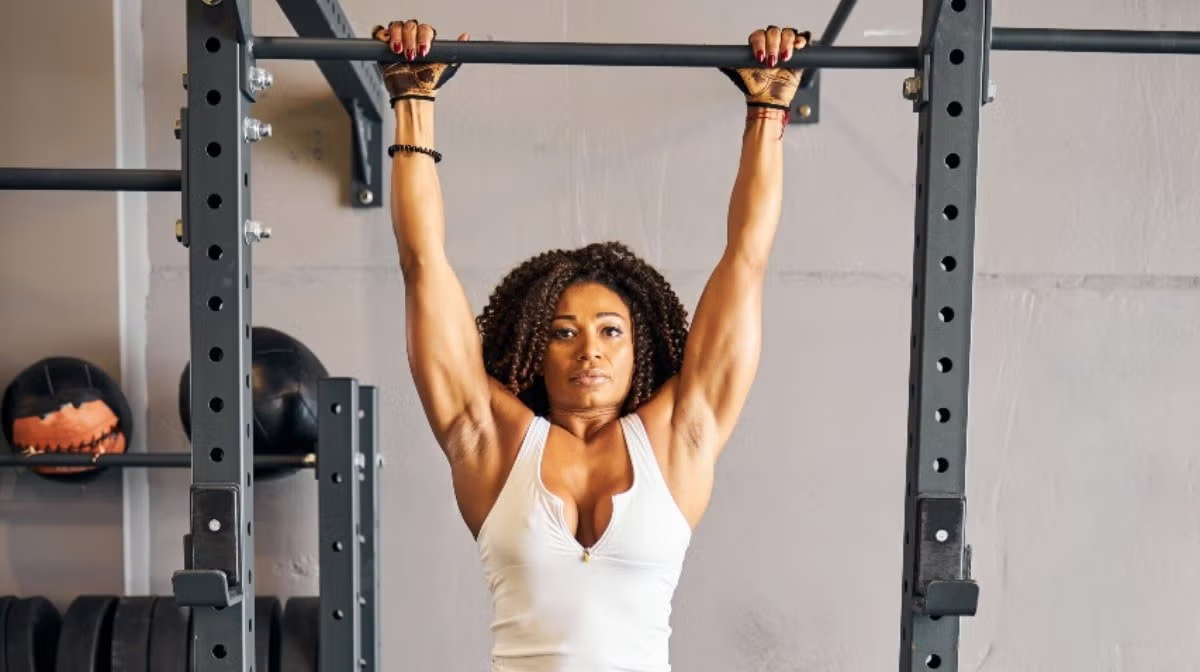
Dead Hang for Upper Body Endurance
Ever watched those ninja warrior shows where contestants hang from bars with seemingly superhuman grip strength? That’s the power of dead hangs in action.
Dead hangs might look simple – just grab a bar and hang – but they’re secretly one of the most effective upper body isometric exercises you can do.
How To Do A Perfect Dead Hang
- Find a pull-up bar or sturdy overhead surface
- Grip the bar with both hands slightly wider than shoulder-width apart
- Lift your feet off the ground completely
- Keep your shoulders engaged (don’t let them creep up to your ears)
- Hang with straight arms for as long as possible
- Breathe normally throughout
Don’t have a pull-up bar? No problem. A sturdy tree branch, playground equipment, or even the top of a doorway (if it’s solid) can work in a pinch.
What Dead Hangs Actually Do For Your Body
When you’re just hanging there, seemingly doing nothing, your body is working overtime:
- Your grip strength skyrockets (goodbye weak handshakes)
- Your shoulders decompress and stretch
- Your lats, biceps, and forearms engage isometrically
- Your core activates to keep your body stable
- Your spine elongates, potentially helping with posture
The beauty is that dead hangs require zero equipment beyond something to hang from. And trust me, when you hit the 30-second mark and your forearms are screaming, you’ll know it’s working.
Start with 10-15 second holds if you’re new, then gradually build up. Some fitness freaks can hang for minutes at a time, but even 30 seconds is impressive.
Glute Bridge Hold for Posterior Chain Strength
Glute Bridge Hold for Posterior Chain Strength

The glute bridge hold stands as one of the most effective isometric exercises for developing posterior chain strength. This simple yet powerful movement targets multiple muscle groups simultaneously while requiring minimal equipment.
Activate hamstrings and glutes for better posture
Glute bridge holds specifically target and activate your hamstrings and gluteal muscles, which play a crucial role in maintaining proper posture throughout the day. By strengthening these posterior chain muscles, you’ll experience:
- Improved lower back support
- Enhanced pelvic stability
- Better overall posture, especially when sitting for long periods
- Increased strength in your entire backside
With regular practice, this exercise helps counteract the negative effects of prolonged sitting, which often leads to weakened glutes and poor posture.
Proper hip positioning and core bracing
To maximize the benefits of the glute bridge hold, proper form is essential:
- Lie on your back with knees bent
- Position your heels approximately 12-16 inches from your buttocks
- Press firmly into your heels
- Brace your core muscles
- Push your pelvis upward by squeezing your glutes tightly
- Maintain a neutral spine position
When executing the movement, ensure your ribs don’t flare outward. Keep your tailbone slightly tucked under, with your abdominal muscles engaged throughout the exercise. Your feet should remain flat on the floor, creating a stable base for the movement.
Common form mistakes to avoid
Even with this seemingly simple exercise, several form mistakes can reduce effectiveness and potentially lead to discomfort:
- Allowing hips to sink: This reduces muscle activation and places strain on your lower back
- Excessive back arching: Creates compression in the lumbar spine instead of working the target muscles
- Insufficient glute engagement: Relying too much on lower back muscles instead of gluteal contraction
For optimal results, perform 2-3 sets of 30-second holds, gradually increasing duration as your strength improves. Focus on quality over quantity, ensuring proper muscle activation throughout each hold.
V-Hold for Advanced Core Stability
V-Hold for Advanced Core Stability

The V-hold exercise stands out as a powerhouse movement for those seeking to develop advanced core stability. This challenging position targets multiple muscle groups simultaneously, creating an efficient and effective strengthening exercise.
Challenge abdominals and hip flexors
The V-hold primarily engages your abdominal muscles and hip flexors in a unique way that few other exercises can match. By maintaining this position, you’re creating constant tension across your entire core region, which helps develop not just strength but also stability and endurance. This isometric hold requires your body to work against gravity, forcing your muscles to engage continuously throughout the duration of the exercise.
Unlike dynamic movements that allow for momentary relief during repetitions, the V-hold demands constant activation, making it particularly effective for building core strength. Your rectus abdominis (the “six-pack” muscles) work in coordination with your transverse abdominis (deep core muscles) and hip flexors to maintain proper positioning.
Modifications for different fitness levels
The V-hold can be adapted to accommodate various fitness levels:
- Beginner modification: Keep your arms by your side instead of extending them forward. This reduces the leverage and makes the exercise more manageable while still providing significant core engagement.
- Intermediate adjustment: If you find straight legs too challenging or notice your back rounding, slightly bend your knees. This modification helps maintain proper spinal alignment while still targeting the core muscles effectively.
- Form consideration: Focus on keeping your spine long rather than allowing your lower back to round, which can put unnecessary stress on your back.
These modifications ensure that you can perform the V-hold safely while still receiving the core-strengthening benefits, regardless of your current fitness level.
Breathing techniques during the hold
Proper breathing is crucial during the V-hold exercise:
- Continue breathing throughout the entire duration of the hold rather than holding your breath
- Practice steady, controlled breaths to help maintain core engagement
- Avoid shallow chest breathing, instead focusing on deep diaphragmatic breathing
- Maintain proper posture by keeping your back straight and shoulders pulled back, not rounded forward
Proper breathing technique not only helps you maintain the position longer but also ensures that your muscles receive adequate oxygen during this challenging isometric exercise. Remember that tension without proper breathing can lead to increased blood pressure and decreased exercise effectiveness.
Calf Raise Hold for Lower Leg Power
Calf Raise Hold for Lower Leg Power

Having explored various isometric exercises for different muscle groups, let’s now focus on a powerful movement for your lower legs that you can easily incorporate into your home workout routine.
Strengthen Gastrocnemius and Soleus Muscles
The calf raise hold specifically targets two crucial muscles in your lower legs: the gastrocnemius (the larger, more visible calf muscle) and the soleus (the deeper muscle beneath it). When you perform and hold this exercise, these muscles work isometrically to maintain the elevated heel position, creating tension that stimulates muscle fiber growth and strengthens connective tissues. This not only helps in developing more defined calves but also contributes to functional strength that supports everyday movements like walking, running, and climbing stairs.
Balance and Stability Improvements
Beyond just muscle development, consistent practice of calf raise holds delivers significant improvements to your overall balance and stability. The exercise engages the small stabilizing muscles in your ankles and feet, which are essential for maintaining proper posture and preventing falls. As these muscles become stronger, you’ll notice enhanced coordination and greater confidence in movements that require balance. This improved stability translates to better performance in other exercises and daily activities.
Single-Leg Variations for Added Difficulty
Once you’ve mastered the standard calf raise hold, you can progress to more challenging variations to continue your strength development. The single-leg calf raise hold is particularly effective, as it doubles the weight load on the working leg while introducing an additional balance challenge. To perform this variation, simply lift one foot off the ground while performing the exercise, maintaining the raised heel position with your body weight supported by just one leg. Remember to switch sides to ensure balanced development. This progression ensures your lower legs continue to adapt and strengthen as your fitness level advances.
Essential Safety Tips and Best Practices
Essential Safety Tips and Best Practices
Focus on proper form over duration
When performing isometric exercises, prioritizing correct form is crucial for effectiveness and safety. Many beginners make the mistake of attempting to hold positions for extended periods while their form deteriorates. Remember that a 10-second hold with perfect form delivers far greater benefits than a 30-second hold with compromised alignment.
If you notice your body shaking excessively or your position shifting, this indicates it’s time to end the exercise. The moment proper form cannot be maintained, discontinue the hold rather than pushing through with incorrect positioning. This approach prevents potential injuries and ensures each exercise effectively targets the intended muscle groups.
Active muscle contraction techniques
Isometric exercises aren’t just about remaining still—they require intentional muscle engagement. To maximize benefits during holds, focus on actively contracting the target muscles. For example, during a plank, don’t simply hold yourself up; actively push the ground away while drawing your navel toward your spine and squeezing your glutes.
This deliberate tensioning creates greater muscle fiber recruitment, leading to superior strength development and endurance gains. Think of each isometric hold as an opportunity to create maximum tension in the working muscles, rather than passively remaining in position.
Breathing patterns and injury prevention
One common mistake during isometric exercises is breath-holding, which can increase blood pressure and reduce exercise effectiveness. Establish a consistent breathing pattern throughout each hold—inhale deeply through your nose and exhale slowly through your mouth.
For most isometric exercises, aim to maintain normal, rhythmic breathing. If you find yourself holding your breath, it may indicate that you’re straining beyond your current capabilities. Proper breathing not only enhances oxygen delivery to working muscles but also serves as a crucial injury prevention mechanism.
The combination of proper form, active muscle contraction, and appropriate breathing patterns creates a foundation for safe, effective isometric training. By adhering to these best practices, you’ll maximize results while minimizing injury risk.
Special Considerations for Different Populations
Special Considerations for Different Populations
Benefits for older adults and joint health

Isometric exercises present a valuable opportunity for older adults looking to maintain or improve their muscle strength. One of the key advantages is that these exercises put minimal pressure on the joints while still effectively building strength. This makes them particularly suitable for individuals with joint concerns or those who find dynamic movements challenging.
Research supports these benefits, with a 2015 study highlighting that older adults who incorporated isometric exercises into their fitness routines experienced notable improvements in posture and walking gait. These functional improvements can translate to better mobility and independence in daily activities, which is especially important for maintaining quality of life as we age.
Blood pressure considerations and precautions
While isometric exercises offer numerous benefits, they require special attention regarding cardiovascular health. Some research indicates that regular isometric training can actually help manage and lower high blood pressure over time, making them potentially beneficial for cardiovascular health.
However, it’s important to note that during the actual contraction phase of isometric exercises, there may be temporary increases in blood pressure. For this reason, individuals with diagnosed high blood pressure or heart disease should approach isometric training with caution. Medical consultation before starting an isometric exercise program is strongly recommended for these populations to ensure safety and appropriate exercise selection.
Customizing exercises for your fitness level
One of the greatest strengths of isometric training is its adaptability across fitness levels. These exercises can be easily modified to accommodate beginners, intermediate exercisers, and advanced fitness enthusiasts alike.
For those just starting out, adjusting the duration of holds is the simplest way to customize the challenge. For example, beginners might start with shorter plank holds of 10-15 seconds, gradually building up to longer durations as strength improves. As your fitness level advances, you can progressively increase the hold time to continue challenging your muscles and seeing improvements.
This progressive approach allows individuals to build strength over time at their own pace, making isometric exercises accessible to virtually anyone regardless of their starting point.

Isometric exercises offer a powerful way to strengthen your entire body without the need for expensive equipment or a gym membership. By incorporating these six essential isometric moves—wall sits, planks, isometric squat holds, overhead holds, glute bridge holds, and V-holds—into your regular routine, you can build strength, improve stability, and enhance muscular endurance right from the comfort of your home.
Remember to focus on proper form, breathe consistently throughout each hold, and start with shorter durations if you’re a beginner. Whether you’re recovering from an injury, limited on space, or simply looking to add variety to your workout regimen, these isometric exercises can be tailored to your fitness level. Challenge yourself gradually by increasing hold times as you get stronger, and you’ll soon notice impressive improvements in your overall strength and body stability.
